

Forward Looking Implications of Consumption Behavior in the Trump 2.0 Era
[ad_1] Aggregate consumption drops as income ex-current transfers rises. The pattern of disaggregated consumption pattern suggests tariff-induced front-loading drove some of the support for consumption

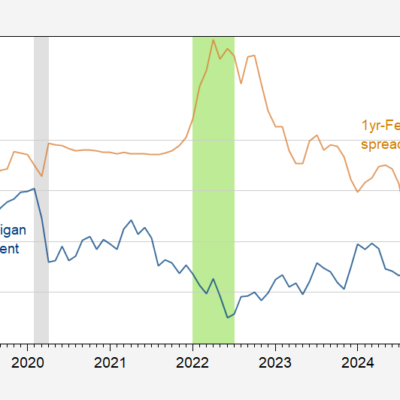
Bordo-Siklos Central Bank Credibility, using Michigan Expectations
[ad_1] Using final March numbers: Figure 1: Bordo-Siklos measure of central bank credibility, using 5 year Michigan expectations (blue). Assumes 2.45% CPI inflation is consistent

Term Spreads, Yield Curves, 28 March 2025
[ad_1] Big drop in one year to two year part of the spectrum suggests deceleration in growth in a year. Time series: [ad_2] Source
Why 2025 is not 2022 (Short-Horizon Recession Forecasting-Wise)
[ad_1] Reader Bruce Hall comments on this post showing the implications of a short horizon probit model of recession likelihood. Perhaps I didn’t remember correctly,

Near Horizon Recession Probability | Econbrowser
[ad_1] I run a probit regression of a NBER peak-to-trough recession dummy on contemporaneous Michigan sentiment (FRED variable UMCSENT, and final reading for March) and
Business Cycle Indicators for February: What Does It Mean When Consumption Falls while Income Rises?
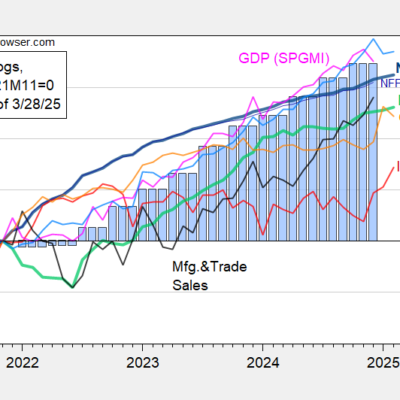
[ad_1] Personal income growth at +0.8% m/m vs +0.4% Bloomberg consensus, while consumption growth is +0.4% m/m vs 0.5% consensus. GDPNow adjusted for gold imports

More on the Mar-o-Lago Accord Malarky: “be afraid…be very afraid”
[ad_1] From Steve Kamin, two pieces: [1] [2]. A succinct summary: So all told, Miran’s suggested options to lower the dollar while containing interest rates
2024Q4 GDP, GDO, GDP+, and Nowcasted Consumption Crash
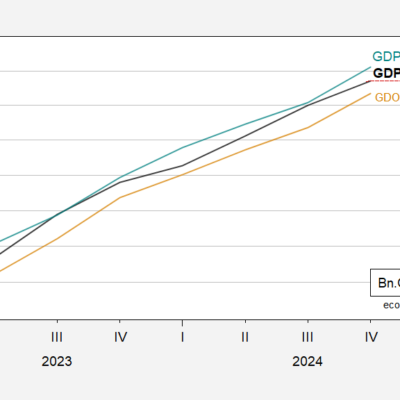
[ad_1] Third release on GDP. We now have a reading on GDO, as well as an updated view on GDP+. Figure 1: GDP (black), GDO
GDPNow Bouncing near Zero | Econbrowser
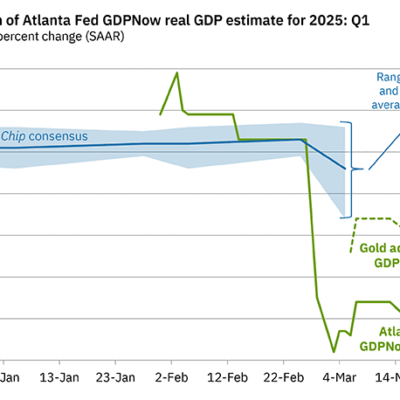
[ad_1] From Atlanta Fed today: Source: Atlanta Fed, accessed 3/26/2025. What’s this mean for the trajectory of GDP? Note GS at 1.3%, while NY Fed
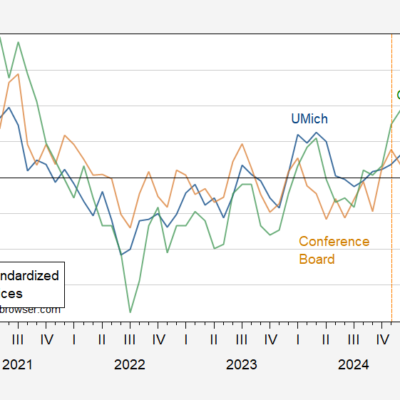
Conference Board: “US Consumer Confidence tumbled again in March”
[ad_1] Conference Board confidence index at 92.9 vs. 94.2 consensus. Here’s confidence vs. U.Mich sentiment (all standardized). Figure 1: U.Michigan Economic Sentiment (blue), Conference Board Confidence